
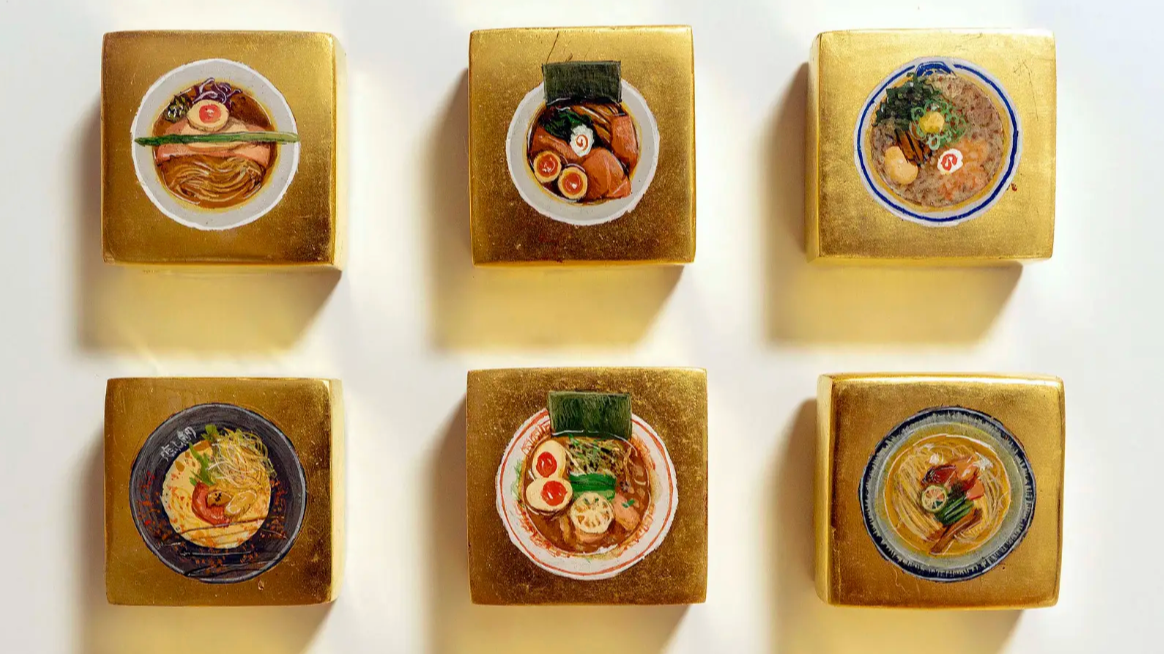
Nanami Hayashi, Ramen, 2022-2026
Like so many things, a flavor or a cuisine cannot be judged after a single tasting (…) The first time, we are always unsettled by a new flavor, by a cooking technique, by a combination of tastes we have never encountered before; we simply lack the words to describe it.
In her book Fade, author Ryoko Sekiguchi examines a notion that has long been associated with cuisines unfamiliar to us. She shows that when we describe a food as "bland," we reveal less about the cuisine we are judging than about the limits of our own perception. From this observation, and without lapsing into the kind of fatalism that suggests "we can never truly understand," or that such understanding is "reserved for connoisseurs," Sekiguchi offers a hopeful perspective: to truly grasp a cuisine, we must first unlearn our own culinary "grammar" and approach it with the humility, but also the optimism, of someone learning an unfamiliar language.
NAFAS is part of this movement. Founded in 2022 by Lucien Zayan, director of The Invisible Dog, a New York-based nonprofit arts organization, the second Tokyo edition of the festival will take place from September 4 to 26, 2026, in partnership with BUoY Arts Center, an art center dedicated to emerging artists envisioned by Kako Kishimoto. Around sixty Japanese and international artists, working across a wide range of disciplines, will explore food in an attempt to answer a series of questions that are at once simple and fundamental. What does it mean to eat? What significance does a meal hold when you were born in Osaka or Paris, or when you come from Akron, Ohio? When you live alone in a converted factory in Brooklyn, or share a 40-square-meter apartment with four others in a danchi, a public housing complex on the outskirts of Tokyo? When we cook for someone, are we merely feeding them? And what becomes of food once it has been consumed? Does it cease to be food the moment it passes our lips?
These questions have long fascinated anthropologists. Food is perhaps the most natural gateway into a culture. It bears witness to the constant movement of cultural exchange, exile, and migration. It speaks of family transformations, gender relations, and systems of domination. It accompanies society through its changes. If sushi, a simple slice of raw fish served on a ball of vinegared rice, has become so popular in the West that it is now routinely delivered to people's homes to accompany a football game among friends, it is because it has adapted to a cultural and social context fundamentally different from that of its country of origin. It is no less authentic than the sushi served at a Michelin-starred restaurant in Tokyo, just as we do not become "less" ourselves when we move to a new country or change the way we dress. It has simply become something different.
What we eat ultimately says as much about us as the clothes we wear or the music we listen to. California avocado toast and Texas barbecue: are these really the fault lines between Democrats and Republicans in the United States? If such clichés remain deeply embedded in our collective imagination, it is not because certain foods belong exclusively to certain groups of people, but because eating is fundamentally a political act.
During his campaign for mayor of New York, socialist candidate Zohran Mamdani was asked about his favorite restaurants. His answer: Kebab King, Pye Boat, a popular Thai restaurant, and Zyara, known for its Mediterranean cuisine. Were these simply personal preferences, or a political strategy to connect with ordinary New Yorkers? Probably both. One thing is certain, however: these choices contributed to the popular support that carried New York's first Muslim mayor.
In France, meanwhile, the "giant banquets" where people gather over cured meats, red wine, hearty laughter, and the songs of Michel Sardou or Charles Aznavour have recently been embraced by right-wing political parties, confident they will find future voters there. Is pad thai progressive and salami conservative? Fortunately, food is alive, and what holds true today may no longer be true tomorrow.
During Japan's Edo period (1603–1868), white rice was associated with the upper classes, while peasants made do with brown rice. Today, the opposite trend is emerging: residents of Tokyo's affluent neighborhoods proudly choose brown rice for its superior nutritional value. Back in North America, avocados are increasingly shunned for environmental reasons; Texas is attracting young creatives fleeing a California transformed into the kingdom of Big Tech; and slow-smoked barbecue has become a staple of Brooklyn's trendiest restaurants. Food does not freeze identities in place; it evolves alongside them. Culinary traditions, far from being dead languages, are constantly being reinvented.
If food is political, it is also inseparable from relations of power. Beyond questions of taste or identity, it has long served those in power as a means of maintaining dominance, or even subjugating others. At the beginning of the twentieth century, German colonial forces seized arable land and poisoned water sources in Namibia, leading to the deaths of tens of thousands of Herero people. Closer to our own time, Ukrainian prisoners of war have emerged from Russian prisons emaciated, starved, and traumatized. In Jenin, in the occupied West Bank, the Israeli army has systematically uprooted olive trees, the economic and nutritional backbone of much of the Palestinian population. Food stands at these two extremes: it makes life possible, yet its absence inevitably leads to death.
These complex questions, which resist simple answers, provide fertile ground for artistic exploration. For NAFAS Tokyo, where most of the works will be created specifically for the exhibition, visual artist Yuka Kaneko examines the persistence of food taboos through videos in which she digitally inserts herself eating in public, an act still widely frowned upon in Japan. Franco-Lebanese artist Beyboun Sama draws on her family's recipes to explore the role of memory in cooking and the central place of matriarchy. Franco-American baker Emmanuel Reckel will spend three weeks in Japan investigating the art of fermentation, while artist Calvin Stalvig will work with candle-making. Japanese photographer Mari Katayama, an avid cookie enthusiast, will come to... bake cookies. In doing so, she quietly questions what we expect from an artist once they step outside the medium to which they have been assigned.
"Whatever we do, certain nuances, certain sounds, certain expressions and aspects of grammar will always resist translation, or their functions will inevitably change in the process. How can we translate the role of elements that cannot simply be reduced to 'taste'? The importance of texture? Of temperature? The relative balance of these elements from one culture to another?" Ryoko Sekiguchi asks once again.
Art, as a universal language, may offer the beginning of an answer, or at least provide a new vocabulary. By revealing the emotions and sensory worlds that surround food, along with the countless imaginaries it carries, art allows us to read a cuisine differently: to understand the people who eat it, the society that transforms it, celebrates it, or, conversely, seeks to erase it.
In Arabic, nafas means "breath." But it also refers to the rare gift some people possess for cooking, not merely well, but exceptionally well. As a political object, food demands a reading that extends far beyond gastronomy, botany, or nutrition. Only then can we fully grasp the significance of a question as ordinary as it is universal:
"So, did you eat well?"
Emil Pacha Valencia is journalist, photographer, publisher, and editor-in-chief of Tempura magazine.
More information about NAFAS Festival, list of artists, events etc etc here