
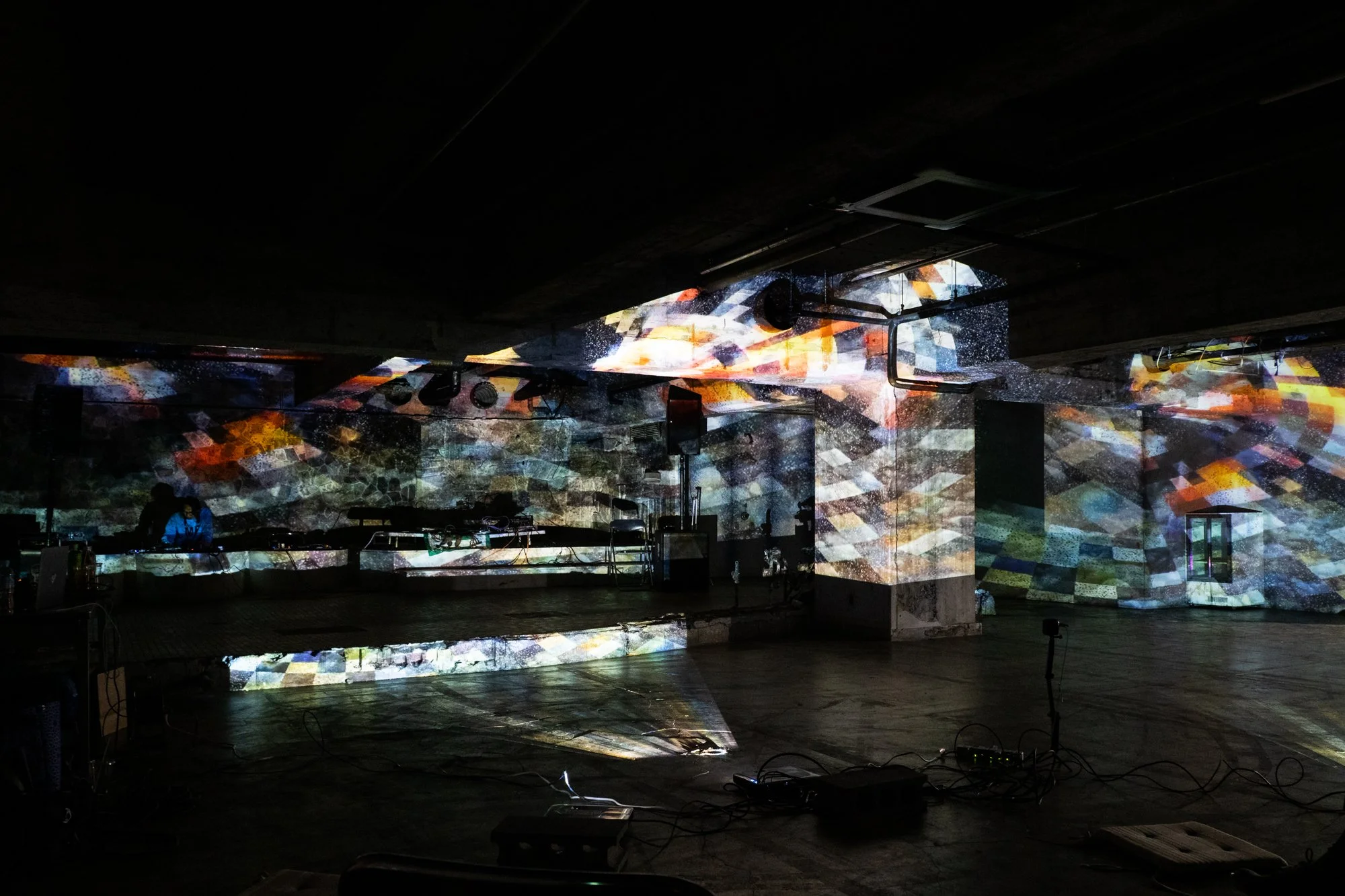
“無為フェス -vol.3- Theme: The Breath of Silence” November 10, 2025, BUoY (Tokyo) Photo: Yusuke Inoue
The Invisible Dog (New York City) and BUoY Arts Center (Tokyo) are thrilled to present a multi-projectiont and live music performance by Kiyoshiro Tatekawa.
This performance is part of NAFAS, an international festival exploring the relationship between art and food with an exhibition of 70 artists and a series of performances, workshops and events. Discover the full program here
It has been written somewhere that zoos exist as nostalgic reminders of a time when humans, too, were animals. Although the first modern zoo, the Schönbrunn Zoo, opened in 1752, the very idea of the zoo likely emerged much earlier, as civilization developed and humans began to separate themselves from the natural world.
A zoo is a place where every aspect of life, shelter, food, reproduction, even movement, is controlled by its administrators. In this sense, the zoo becomes a powerful metaphor for the modern city. Like animals in captivity, urban dwellers depend almost entirely on systems managed by others. Our access to food, water, energy, and safety is sustained by infrastructures that remain largely invisible until they fail.
The Great East Japan Earthquake and the COVID-19 pandemic revealed just how fragile these systems can be. When distribution networks are disrupted, essential supplies disappear, livelihoods are threatened, and freedom of movement is restricted. In such moments, people are forced to entrust their survival to institutions and administrators. Cities may prepare for emergencies, but they remain vulnerable to the unpredictable forces of nature.
Water and food are not inherently found in cities, they are brought there. Yet many people living in contemporary urban environments have lost the knowledge and means to provide for themselves outside these systems. The conveniences of city life conceal a persistent vulnerability, one that grows as cities become larger and more complex.
Animals, by contrast, can survive beyond the boundaries of the zoo. They build shelters, find food, and adapt to their environments. Humans once possessed these same abilities, yet have gradually distanced themselves from the natural world.
So what do we really see when we look at animals in a zoo? Are we observing another species or are we confronting reflections of ourselves? Perhaps the zoo does not simply preserve the past of humanity, but reveals its present, and even hints at its future.
Tatekawa Kiyoshiro works and lives in Tokyo. He explores video art through an overwhelming volume of work and experimental techniques, centered on the theme of “reconstructing vision.”
He constructs experiential art spaces that challenge the very act of “viewing video.” The viewer’s gaze wanders, becomes enveloped by the space, and is drawn to the details. For those who can enjoy this process, the exhibition is incredibly stimulating. Viewers will engage with the works relying solely on their own senses. What are they seeing? Where do they find meaning? At what moment are they moved? The greatest appeal of the exhibition lies in how these “habits of one’s own vision” are laid bare.
1. An Overwhelming Volume of Work and Works as “Plans”
An extraordinary production pace of 200 videos over three years. The collection of a vast number of short films itself constitutes the artwork, rather than any single piece. Continues production under the project format known as the “Three-Year Plan”
2. “Material Images” That Exclude Narrative
Thoroughly excludes stories and explanations Treats zoo animals, urban landscapes, and human movements as pure visual phenomenaA structure that prompts viewers to reexamine “what it means to see” A strong stance of treating video not as “information” but as a “phenomenon”
3. Interest in Gaze, Surveillance, and Fluctuations in Presence
Beginning with filming at zoos, the work has evolved toward a surveillance-camera-like perspective of the city. The “Gaze” series explores the “being watched/watching” structure of social media and the surveillance society.Focuses on subtle shifts in the subjects’ sense of presence
4. Experiments with Screening Formats (Gauze Screens, Multi-Projection, VJ-Style Reconstruction)
Goes beyond single-screen projections to utilize gauze screen projections and multi-projection setups. Also incorporates VJ-style techniques to reconstruct footage in real time during screenings. Designs the very experience of “how to view the footage”. The use of exhibition space is highly experimental
5. An Artistic Approach That Transcends the Boundaries Between Photography and Video
Many works blur the line between still images and moving images. Features a unique treatment of “time,” creating footage that resembles photography and photographs that resemble video
Location
BUoY Arts Center / Basement
49-11, Senju-Nakacho, Adachi-ku,
Tokyo
Admission:
Free
Date
Friday September 4, 2026
at 7.30PM
Duration approximately 40mn
As part of the opening reception of NAFAS Festival Tokyo